
DOL Final Rules on Independent Contractor Classification
One of the most frequently asked questions clients have is whether someone providing services to their business should be classified as an employee or an independent contractor.
Unlike so many other issues, the Internal Revenue Service does NOT have an exact statute that provides the definition of who qualifies as an employee. Instead, they depend upon Treasury Regulations Section 31.3121(d) – 1 (c), paragraphs (1) and (2), which describes “The right to direct and control.”
Previously, in an effort to clarify this issue, the IRS provided a 20-point test in which each item related to the concept of control. Following is a partial list of these items:
- Where are services performed?
- When are services performed?
- How are services performed?
- What type of pay does the service provider receive?
- Who provides the tools and supplies needed to perform services?
- Can the service provider work for multiple entities?
More recently, these 20-points were organized to provide “Evidence of Control” under these three categories:
- Behavioral Control – Including whether instruction, training and evaluations are provided to the worker.
- Financial Control – Including how workers are paid, whether expenses are reimbursed, and whether the worker offers their services to the marketplace.
- Type of Relationship – Including written contracts, whether benefits are offered, the permanency of the relationship, and whether the worker provides services that are key aspects of the business.
Questions to help determine the “Evidence of Control” are expanded in the preparation of Federal Form SS-8. While filing Form SS-8 is not necessarily recommended, by answering these questions included on Form SS-8, you can determine substantial guidance in determining whether a service provider should be treated as an employee or an independent contractor.
While the above criteria help to answer the question of employee versus independent contractor status for the IRS, the Department of Labor ruling is slightly different.
On March 11, the DOL published a final rule revising their guidance on how to analyze whether someone is an employee or an independent contractor under the Fair Labor Standards Act (FSLA) – Fed. Reg. 1638. In essence, the new guidance rescinded the Independent Contractor Status Under the FSLA that was published on January 7, 2021, (2021 IC Rule) and replaced it with an analysis for determining employee or independent contractor status that is more consistent with the FLSA as interpreted previously by longstanding judicial precedence. This new guidance is much more in line with the guidance provided by the IRS.
While there is no single rule for determining whether an individual is an independent contractor or an employee under FLSA, the Economic Reality Test looks to the facts of a situation rather than assuming that a written label, contractual arrangement, or form of business decides the outcome. To analyze if a worker is an employee or independent contractor, the final rule provides six factors that businesses and workers should consider when analyzing the economic realities of the working relationship:
- Is there an opportunity for profit or loss depending on managerial skills?
- Is there an investment by the worker and the potential employer?
- What is the degree of permanence of the work relationship?
- What is the nature and degree of control over the worker?
- What is the extent to which the work performed is an integral part of the potential employer’s business?
- What impact do skills and initiative have on the completion of the work?
Finally, it should be noted that no one factor or subset of factors determines if a worker is an employee or an independent contractor. Rather, all circumstances of the relationship should be examined. The weight given to each factor may depend on the facts and circumstances of the particular relationship. Also, additional factors may be relevant if they, in some way, indicate if the worker is in business for themselves as opposed to being economically dependent on the employer for work.
The following is a summary of the comparison of Indicators that a worker is an Employee versus an independent contractor:
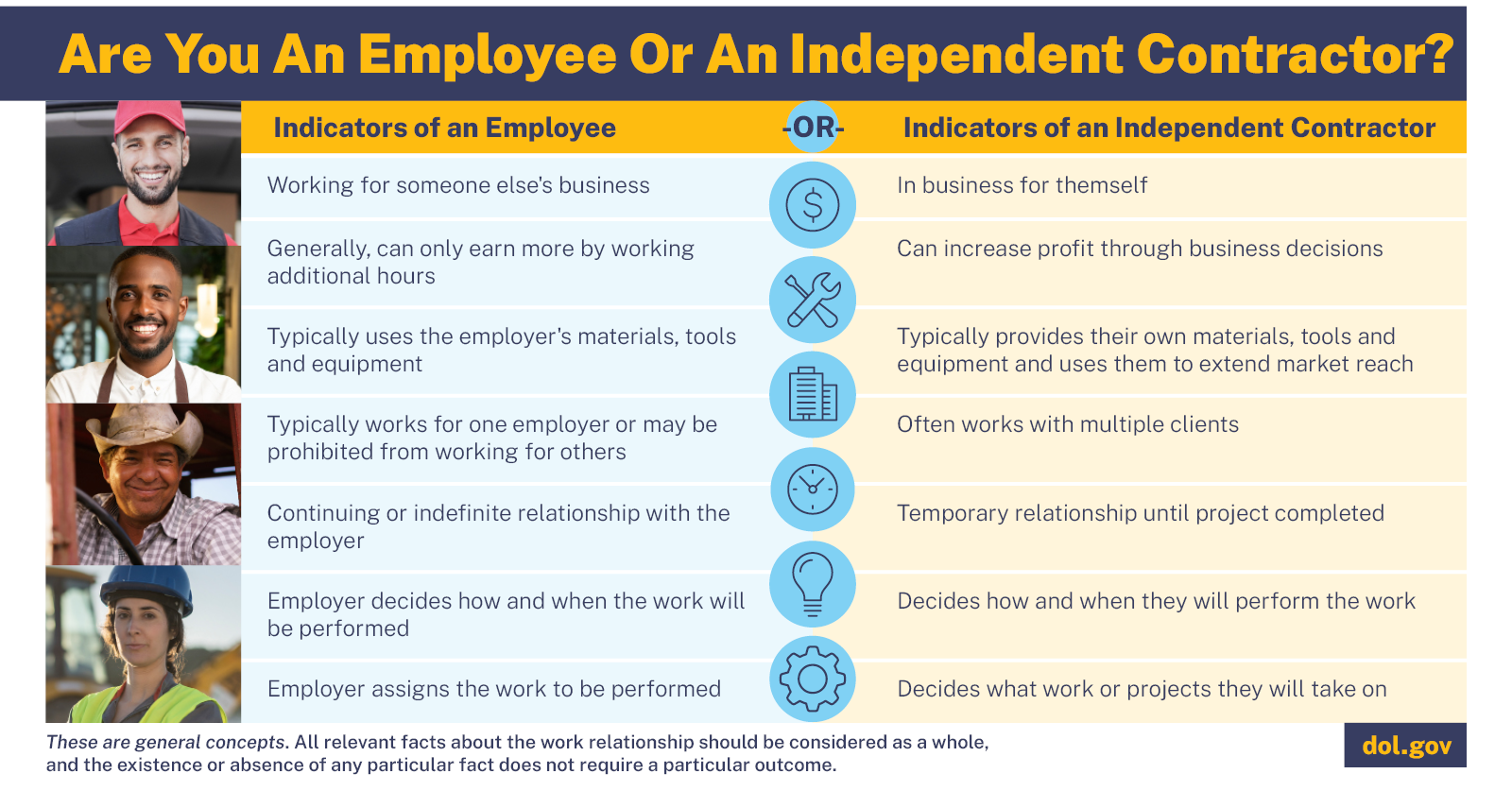
If you have any questions regarding the classification any worker relationships that you may have or are considering entering into, please feel free to contact your Zinner Client Service Team member to discuss the situation. We are here to help!