Blog & Newsroom

Not-for-Profit? Learn How the Recent Accounting Standards Could Affect Your Organization

Not-for-Profit? Learn How the Recent Accounting Standards Could Affect Your Organization

The giving cycle. Funding cuts. Grant applications. Today, many professionals responsible for the fiscal health of a not-for-profit are consumed with a variety of concerns that impact the bottom line. Adding to that, the recent Financial Accounting Standards Board (FASB) proposed changes are certainly concerns that cannot be overlooked.

Tax-Audit-1.png According to the National Center for Charitable Statistics (NCCS), more than 1.5 million nonprofit organizations are registered in the U.S. This number includes public charities, private foundations, and other types of nonprofit organizations, including chambers of commerce, fraternal organizations and civic leagues. The concern?  The FASB changes will affect nearly all not-for-profit entities who issue financial statements.

read more…
Electronic Delivery of Invoices to Begin January, 2018

Electronic Delivery of Invoices to Begin January, 2018

Fall 2017 | Winter 2018

Zinner & Co. is ready to ring in the New Year with a commitment to sustainability, focus on our environment, and assurance that our clients receive year-round service.  Cleveland CPAs help clients with sustainability .jpegAs part of this initiative, beginning in January 2018, business client invoices will be delivered via electronic mail. To ensure timely and effective receipt of your invoice, please take a moment to update your company information by downloading the form here and adding your billing department information if it is different than your primary company contact. (Please let us know if you prefer to continue to receive your invoice via USPS). You can return the form to us at ClientUpdate@zinnerco.com or via US mail:

read more…

How Can I Possibly Plan at Age 30?

How Can I Possibly Plan at Age 30?

Financial planning at any age can be challenging, and more so, when one is approaching or a few years removed from turning 30. So many life-changing events that ultimately, affect one’s personal budget. Zinner-EBook-SEPT16-Cover.jpg

Every so often, we come across a great article that catches our attention and hits the nail on the head. We are thrilled to share this great read with you from Anne Bucciarelli and the folks at Bernstein.com. 

Did you like it too? Drop us a line; we’d love to hear from you and should you have any questions about financial planning, tax strategies, or business advisory, we’re happy to help and ready to start the conversation. Contact us at 216.831.0733 or info@zinnerco.com 

Download our FREE Ebook, What to do Before Saying I Do

All in (or out of) the Family:  Who will inherit the family business?

All in (or out of) the Family:  Who will inherit the family business?

As a business owner, one often invests much time and energy into the day-to-day operations.  As a result, many owners are likely to sidestep or forget to take the time to establish a long-term plan for the business and simply presume their child will hold the same passion for the business and knowledge in the industry as they have. But, what happens if the child or children have no desire to inherit the business? 
Zinner CPAs help with succession planning .jpeg
First, having a succession plan in place for the business is just as important as having a will for ones personal assets.  Without a succession plan, the company’s future, assets, and legacy are potentially at risk, regardless of who handles the business when an owner retires. 

read more…
Ohio Manufacturer? Sales tax savings that help your business grow

Ohio Manufacturer? Sales tax savings that help your business grow

Manufacturing assembly line stock.jpgLike everything in life, the manufacturing process has a beginning and an end. Understanding that process is important for making business decisions regarding raw materials, staffing, inventory, fixed assets, and innovation. 

This knowledge is also used by well-advised businesses to reduce tax expense in Ohio and many other states that have designed their sales tax structure to promote manufacturing.

Read more from Brett Neate here

Ohio does not require sales or use tax to be paid on the purchase or consumption of items used primarily in the manufacturing operation to produce personal property for sale. One of the challenges in maximizing the benefit of this exemption is understanding, for sales tax purposes, when the production process begins and ends.

Production begins when raw materials are committed to the process and ends when the product is in its final state or form. While these definitions seem straightforward, they tend to incredibly nuanced depending on the product being created and the specific process being utilized by the manufacturer.

An additional challenge in properly applying the exemption is when assets or materials are used in both manufacturing and non-manufacturing processes. For example, forklifts are often used to move raw materials, production items, and finished goods. The cost to purchase, maintain, and power the forklifts may or may not be subject to sales tax depending on whether or not they are used primarily in the production process.

read more…
Tis the Season of Saving: 5 things you can do now to help reduce your taxes

Tis the Season of Saving: 5 things you can do now to help reduce your taxes

In the quest for gifts and seasonal savings together with the promise of continued prosperity, many taxpayers overlook some of the simple year-end moves they can do that will help to reduce their taxes and improve the bottom line.   There are many action steps you can perform today in order to save taxes for the next tax period.  Below, find a shining display of our top five tips to save future tax dollars. Cleveland CPAs help you save on your tax return.jpeg

read more…
Ohio to Offer Tax Amnesty Jan. 1-Feb. 15, 2018

Ohio to Offer Tax Amnesty Jan. 1-Feb. 15, 2018

Ohio taxpayers with outstanding bills will have a window to pay up without penalty.

The Ohio Department of Taxation is offering amnesty from Jan. 1 to Feb. 15, 2018 to individual and business taxpayers.

Tax commissioner speaks at Columbus Accounting Show

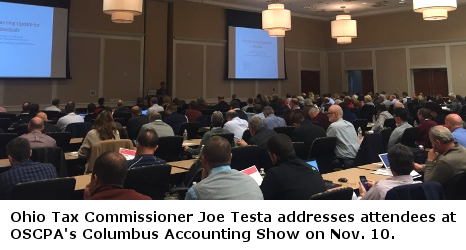
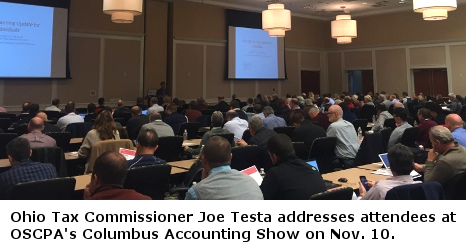
ODT has launched a statewide campaign to raise awareness of the amnesty. Ohio Tax Commissioner Joe Testa kicked off the effort Nov. 10 by discussing the issue with attendees at OSCPA’s Columbus Accounting Show.

The Department of Taxation will offer amnesty on the following:

    • Individual taxes
    • School district income taxes
    • Employer withholding taxes
    • Employer withholding for school district income taxes
    • Pass-through entity taxes sales tax
    • Use taxes
    • Commercial activity
    • Financial institutions
    • Cigarette and other tobacco products
    • Alcoholic beverage

Amnesty is available only for taxes that were due and payable as of May 1, 2017, and still remain underreported or unreported. Those who fully pay qualifying tax delinquencies will owe no penalties and only half the interest normally charged. The program does not apply to any tax for which a notice of assessment or audit has been issued, for which a bill has been issued, that relates to a still-open tax period, or for which an audit has been conducted or is pending.

Taxpayers can learn more and determine eligibility at www.OhioTaxAmnesty.gov; or by calling 800-304-3211.

This article appears courtesy of the Ohio Society of CPAs Community News published Nov. 16, 2017. 

Tax_Team.jpg

Sales exempt or excepted from sales tax

sales that are exempt/excepted from sales tax?

  • Copyrighted motion picture films for exhibition purposes unless solely used for advertising. The rental or sale of films or tapes to individuals is taxable.
  • The refundable deposit paid on returnable beverage containers, cartons, and cases.
  • Food for human consumption off the premises where sold (food does not include alcoholic beverages, dietary supplements, soft drinks, or tobacco).
  • Food sold to students in a dormitory, school cafeteria, fraternity or sorority house.
  • Food served without charge to employees as part of their compensation.
  • Items purchased with food stamps.
  • Newspapers (including community newspapers and national newspapers, such as the Wall Street Journal, USA Today, and other unbound publications.).
  • Sales by churches and nonprofit charitable organizations (excluding sales of motor vehicles, titled watercraft, titled outboard motors, off-highway motorcycles, all-purpose vehicles and personal watercraft) not exceeding six days in any calendar year.
  • Sales to nonprofit organizations operated exclusively in Ohio for certain charitable purposes as defined in sales tax law as follows: “Charitable purposes” means the relief of poverty; the improvement of health through the alleviation of illness, disease, or injury; the operation of an organization exclusively for the provision of professional, laundry, printing, and purchasing services to hospitals or charitable institutions; the operation of a home for the aged, as defined in section 5701.13 of the Ohio Revised Code; the operation of a radio or television broadcasting station that is licensed by the federal communications commission as a noncommercial educational radio or television station; the operation of a nonprofit animal adoption service or a county humane society; the promotion of education by an institution of learning that maintains a faculty of qualified instructors, teaches regular continuous courses of study, and confers a recognized diploma upon completion of a specific curriculum; the operation of a parent teacher association, booster group, or similar organization primarily engaged in the promotion and support of the curricular or extracurricular activities of a primary or secondary school; the operation of a community or area center in which presentations in music, dramatics, the arts, and related fields are made in order to foster public interest and education therein; the production of performances in music, dramatics, and the arts; or the promotion of education by an organization engaged in carrying on research in, or the dissemination of, scientific and technological knowledge and information primarily for the public.
  • Sales to churches.
  • Sales to organizations that have been granted and have maintained 501(c)(3) status by the Internal Revenue Service.
  • Sales of personal computers, computer monitors, computer keyboards, modems, and other peripheral computer equipment to an individual who is licensed or certified to teach in an elementary or a secondary school in this state for use by that individual in preparation for teaching elementary or secondary school students.
  • Sales to a veterans’ organization state headquarters.
  • Sales of animals by nonprofit animal shelters and county humane societies.
  • Sales to U.S. government agencies.
  • Sales to the State of Ohio or any of its political subdivisions.
  • Sales to other states and their political subdivisions if they exempt sales to the State of Ohio and any of its political subdivisions.
  • Casual sales except sales of motor vehicles, boats and outboard motors that are required to be titled, snowmobiles, documented boats, all-purpose vehicles, off-highway motorcycles and personal watercraft.
  • Certain rented motor vehicles that are transferred to the owner or lessee of a motor vehicle that is being repaired or serviced, if the purchaser is reimbursed for the cost of the rented motor vehicle by a manufacturer, warrantor, or provider of a maintenance, service, or other similar contract or agreement, with respect to the motor vehicle that is being repaired or serviced. (Effective September 29, 2015)
  • Transportation of property.
  • Motor vehicles sold in Ohio to nonresidents for immediate removal and titling outside the state.
  • Drugs that are or are intended to be distributed free of charge to a practitioner licensed to prescribe, dispense, and administer drugs to a human being in the course of a professional practice and that by law may be dispensed only by or upon the order of such a practitioner.
  • Motor vehicle fuel that is subject to the state motor fuel tax.
  • Motor vehicles and parts used for transporting tangible personal property by persons engaged in highway transportation for hire.
  • Emergency and fire protection vehicles and equipment used by nonprofit organizations in providing emergency and fire-protection services for political subdivisions.
  • Sales of used manufactured homes and used mobile homes, as defined in section 5739.0210 of the Ohio Revised Code, made on or after Jan. 1, 2000;
  • Sales of tangible personal property and services to a provider of electricity used or consumed directly and primarily in generating, transmitting, or distributing electricity for use by others, including property that is or is to be incorporated into and will become a part of the consumer’s production, transmission, or distribution system and that retains its classification as tangible personal property after incorporation; fuel or power used in the production, transmission, or distribution of electricity; and tangible personal property and services used in the repair and maintenance of the production, transmission, or distribution system, including only those motor vehicles as are specially designed and equipped for such use. The exemption provided in this division shall be in lieu of all other exemptions in division (B)(42)(a) of section 5739.02 of the Revised Code to which a provider of electricity may otherwise be entitled based on the use of the tangible personal property or service purchased in generating, transmitting, or distributing electricity.
  • Sales to a professional racing team of any of the following:
    • Motor racing vehicles;
    • Repair services of motor racing vehicles;
  • Items of property that are attached to or incorporated in motor racing vehicles, including engines, chassis, and all other components of the vehicles, and all spare, replacement, and rebuilt parts or components of the vehicles; except not including tires, consumable fluids, paint, and accessories consisting of instrumentation sensors and related items added to the vehicle to collect and transmit data by means of telemetry and other forms of communication.
  • Things used or consumed primarily in storing, transporting, mailing or otherwise handling purchased sales inventory in a warehouse, distribution center or similar facility when the inventory is primarily distributed outside this state to retail stores of the person who owns or controls the warehouse, distribution center, or similar facility.
  • Things used or consumed by a warrantor in fulfilling a warranty on tangible personal property.
  • Sales of drugs for a human being, dispensed pursuant to a prescription; insulin as recognized in the official United States pharmacopoeia; urine and blood testing materials when used by diabetics or persons with hypoglycemia to test for glucose or acetone; hypodermic syringes and needles when used by diabetics for insulin injections; hospital beds when purchased by hospitals, nursing homes and other medical facilities; and medical oxygen-dispensing equipment.
  • The purchase of durable medical equipment for home use, or mobility enhancing equipment, when made pursuant to a prescription and when such devices or equipment are for use by a human being.
  • Tangible personal property used in air, noise or water pollution control facilities by holders of pollution control certificates.
  • Tangible personal property to be resold in the form received.
  • Tangible personal property used or consumed in commercial fishing.
  • Gas, water, steam, and electricity delivered through pipes, conduits, or wires and sold by a public utility or, if applicable, a municipal gas utility.
  • Bulk water for residential use.
  • Tangible personal property incorporated into an energy conversion facility, solid waste energy conversion facility, or a thermal efficiency improvement facility by holders of the appropriate certificate.
  • Telecommunications service to call centers. (No longer an exemption of the sale of 800, WATS, or private communications services).
  • Sales of property for used directly in agricultural production.
  • Property used in the preparation of eggs for sale.
  • Sale and installation of agricultural land tile.
  • Sale and construction of portable grain bins to farmers.
  • Sales to persons licensed to conduct a food service operation of tangible personal property primarily used directly: to prepare food for human consumption for sale; to preserve food which has been or will be prepared for human consumption for sale by the food service operator, not including tangible personal property used to display food for selection by the consumer; and to clean tangible personal property used to prepare or serve food for human consumption for sale.
  • Ships or vessels or rail rolling stock used in interstate or foreign commerce and material used for repairing, altering, or propelling them.
  • Material, machinery, equipment and other items used in packaging property for sale by a manufacturer or retailer.
  • Building and construction material sold to contractors for incorporation into real property of federal, state, or local governments; religious and charitable institutions; a sports facility under section 307.696 of the Ohio Revised Code; or outside this state if exempt by that state.
  • Building and construction materials sold to construction contractors or persons engaged in the business of horticulture or producing livestock for incorporation into a horticulture or livestock structure.
  • Building materials and services sold to a construction contractor for incorporation into a building under a construction contract with an organization exempt from taxation under section 501(c)(3) of the Internal Revenue Code of 1986 when the building is to be used exclusively for the organization’s exempt purposes.
  • Property manufactured in Ohio and immediately shipped outside the state for use in the retail business, if sold by the manufacturer to the retailer and shipped in vehicles owned by the retailer.
  • Material incorporated as part of tangible personal property produced for sale by manufacturing, assembling, processing, or refining.
  • Tangible personal property used or consumed in a manufacturing operation.
  • Sales where the purpose of the consumer is to use or consume the things transferred in making retail sales and consisting of newspaper inserts, catalogues, coupons, flyers, gift certificates, or other advertising material which prices and describes tangible personal property offered for retail sale.
  • Sales to direct marketing vendors of preliminary materials such as photographs, artwork, and typesetting that will be used in printing advertising material; of printed matter that offers free merchandise or chances to win sweepstakes prizes and that is mailed to potential customers with advertising material described in section 5739.02 (B)(35)(a) of the Ohio Revised Code; and of equipment such as telephones, computers, facsimile machines, and similar tangible personal property primarily used to accept orders for direct marketing retail sales.
  • To use tangible personal property to perform a service listed in division (B)(3) of section 5739.01 of the Ohio Revised Code (repair; installation; towing, washing, cleaning, waxing, polishing or painting motor vehicles; transportation of persons, within Ohio, except by public transit systems or commercial airlines; laundry and dry cleaning (except coin operated); automatic data processing, computer service and electronic information service; telecommunications; satellite broadcasting service (audio and video); landscaping and lawn care; snow removal; private investigation and security; 1-900 information; personal care service, including skin care, application of cosmetics, manicures, pedicures, hair removal, tattoos, body piercing, tanning, massage and other similar services (not including hair care such as cutting, coloring, and styling); building maintenance and janitorial; employment; employment placement; exterminating; physical fitness facility; recreation and sports club) if the property is or is to be permanently transferred to the consumer of the service as an integral part of the performance of the service.
  • Parts and services used in repairing and maintaining aircraft with fractional share ownership (private aircraft whose ownership is shared by a group of people).
  • Sales of investment metal bullion and investment coins. (Effective January 1, 2017)
  • Sales of a digital audio work electronically transferred for delivery through use of a machine, such as a juke box, that does all of the following: (a) Accepts direct payments to operate; (b) Automatically plays a selected digital audio work for a single play upon receipt of a payment described in division (B)(55)(a) of this section; (c) Operates exclusively for the purpose of playing digital audio works in a commercial establishment.  (Effective October 1, 2017)

  • “Direct use” exemptions:

    • Material used or consumed directly in mining, farming, agriculture, horticulture, floriculture, or used in the production of and exploration for crude oil and natural gas. Motor vehicles titled and registered to operate on the highways generally do not qualify for exemption.
    • Tangible personal property used directly in rendering a public utility service.
    • Tangible personal property used or consumed in the preparation for sale of printed material.
    • Sales to organizations described in division (D) of section 5709.12 of the Ohio Revised Code.

Note: This list of exemptions is merely an abbreviation of the law. The statutes and rules concerning sales tax exemptions are very long and complicated. Also there are hundreds of court decisions which affect the application of these exemptions. If you have any questions regarding a particular situation, please contact the Department of Taxation.

Since 1938, Zinner has counseled individuals and businesses from start-up to succession. At Zinner, we strive to ensure we understand your business and recognize threats that could impact your financial situation.
Zinner & Co. Sponsors the Epilepsy Association Gala

Zinner & Co. was pleased to sponsor the 27th Annual Epilepsy Association Gala on Friday, November 9, 2018. This year’s event was held at The Westin Cleveland Downtown and featured a night of entertainment that benefited the Epilepsy Association and the important...

Zinner Sponsors the Cleveland Play House’s 2018 Festival of Trees

Zinner & Co. is pleased to sponsor and support our long-time client, The Cleveland Play House, and their 2018 Festival of Trees. This year’s event marks the 19th consecutive year that The Cleveland Play House has hosted its Festival of Trees.  The...

10 Steps to Take to Get Ready for Tax Season

This year’s tax season is going to be different. The new tax laws that took effect for 2018 represent the biggest changes to the tax code in over 30 years. So if you haven’t thought about preparing your taxes for 2018, you’ll want to get a jump on it.  To help...

Send us your questions and we’ll share our insights with you on our blog!

Share Your Idea For 
A Zinner Blog Article